Frustrated with Hard to Heal Foot and/or Leg Ulcers, Chronic Edema or Limb Pain While Walking?

Standard wound care fails to treat the underlying issues, namely poor circulation due to calf muscle pump failure due to a lack of exercise leading to poor circulation and the development of peripheral vascular disease, i.e. Diabetic Foot Ulcers, Stasis Ulcers, and chronic Edema.

Over 60% of patients living with Peripheral Arterial Disease (PAD) or Chronic Venous Disease (CVD) do not participate in daily exercise (walking) which leads to disuse muscle atrophy, calf muscle pump failure, and the development of ulcerations.

  • Osteoarthritis and/or limb pain
  • Musculoskeletal problems
  • Painful foot and/or leg ulcers
  • Bad weather
  • Low motivation to exercise

Nurses, physicians, and patients alike are frustrated with the time it takes to heal Diabetic Foot Ulcers or Venous Stasis Ulcers due to arterial or venous insufficiency.

The VeinOPlus is proven to stimulate calf muscle contractions with a low level of electricity which increases local blood circulation (both venous and arterial) in the lower extremities.

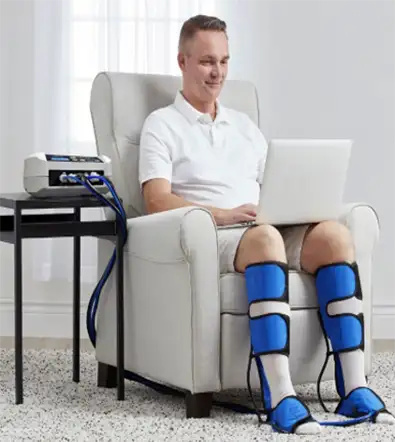
Veinoplus in use

The VeinOPlus promotes mobility, operates in total silence, and delivers pain-free therapy!

Nurses, physicians, and patients alike are frustrated with the time it takes to heal Diabetic Foot Ulcers or Venous Stasis Ulcers due to arterial or venous insufficiency.

  1. Calf Muscle Pump Function ensures 65% of venous blood returns back to the heart for recirculation.
  2. Calf Muscle Pump Failure leads to poor circulation and increased blood sugar levels which increases blood viscosity leading to arterial insufficiency, tissue starvation (O₂), and the possible development of Diabetic Foot Ulcers (DFUs).
  3. Calf Muscle Pump Failure, along with incompetent valves, leads to edema, venous hypertension, and the development of Venous Stasis Ulcers (VSUs).
  4. Stimulating the calf muscle fibers increases local blood circulation for patients living with peripheral vascular disease.

Venous Stasis Ulcer

Diabetic Foot Ulcer

Edema

Claudication Limb Pain

The VeinOPLus is programmed to stimulate calf muscle fibers leading to full calf muscle contractions every second, which increases local blood circulation to the lower extremities so needed in healing and in prevention of recurring tissue breakdown.

Cleared by the FDA and accepted by Medicare and most private insurance companies, the VeinOPlus represents an advanced neuromuscular electrical stimulation device.

Stimulating the calf muscle fibers with VeinOPlus activates the calf muscle pump along with increasing local blood circulation.

Dr. Cywinski, the developer of the VeinOPlus, recognized the underlying issue to poor blood circulation in many cases involved calf muscle pump failure due to a lack of exercise

Veinoplus-Vascular
  • Stimulates the calf muscle pump every second.
  • Improves local blood circulation (venous outflow).
  • Improves local blood circulation (arterial inflow).
  • Prevents muscle disuse atrophy.
  • Relaxes muscle spasms.
  • Provides symptomatic pain relief.

Why make the VeinOPlus device your # 1 treatment strategy for increasing local blood circulation in addressing peripheral vascular conditions?

VeinOPlus excites the calf muscle fibers simultaneously with two electrical impulses in nanoseconds. Key clinical benefits realized with VeinOPlus therapy are an increase in local blood circulation, reduction in symptomatic chronic limb pain, helps prevent retardation of muscle disuse atrophy, helps with muscle re-education, helps prevent venous thrombosis, and helps maintain range of motion.

  • The NMES signal stimulates the calf muscle pump 3,600 times an hour. Each contraction increases local blood circulation, similar to what happens when walking.
  • The TENS signal provides symptomatic pain relief for chronic, acute, or post operative pain.

Clinical studies validate electrical stimulation of the calf muscle fibers by the VeinOPlus does indeed increase local blood circulation to the legs and feet, which helps improve healing, and generates positive outcomes.

VeinOPlus, a neuromuscular electrical stimulation device is cleared by the FDA to increase local blood circulation, which has been proven to reduce edema improve healing!

Increasing local blood circulation helps achieve reduction in chronic edema.

Applying VeinOPlus electrode pads to calf muscles is proven to stimulate and cause calf muscle contractions which increases local blood circulation, positive results, and quality of life.

VeinOPlus is Easy to Use and the Therapy is Pain Free.

5 Easy Steps

  • Apply Electrode Pad to each calf.
  • Connect Interface Cable to VeinOPlus and Electrode Pads.
  • Depress Start/Off button.
  • Depress Intensity button to reach full calf contractions.
  • Auto Shut-Off after one hour of therapy.
  • Patient compliance is high due to positive results during the very first therapy session.
  • VeinOPlus is lightweight, battery powered and promotes mobility during therapy session.

VeinOPlus is completely safe to use.

  • No change in heart rate.
  • Does not cause strokes.
  • Does not cause any measurable limb pain.
  • VeinOPlus must not be used by patients with implanted cardiac pacemakers.

Over 40 countries have chosen the VeinOPlus technology.

Make VeinOPlus Your # 1 Therapeutic Device in Treating Vascular Complications due to Poor Blood Circulation!

The VeinOPlus is proven to stimulate the calf muscle fibers every second which successfully increases local blood circulation in helping resolve circulatory issues leading to chronic edema, limb pain, and tissue breakdown.

Patients report the VeinOPlus successfully:

  • Reduces swelling.
  • Reduces leg pain.
  • Increases local blood circulation.
VeinOPlus

Why treat the calf muscle pump? Dr. Josef Cywinski, the developer of the VeinOPlus taught at MIT and Harvard Medical School. He understood the importance of the calf muscle pump and the role played in pumping 65% of the deoxygenated blood back to the heart for recirculation. Dr. Cywinski realized how poor calf muscle pump function impacts the vascular system in a negative way which leads to decreased local blood circulation and causing peripheral vascular conditions such as edema, claudication limb pain, and ulcerations involving feet and legs. The electrical signal is proven to stimulate the calf muscles fibers which leads to increased local blood circulation, reduces limb pain, helps prevent disuse muscle atrophy, relaxes muscle spasms, re-educates muscles, and increases range of motion which helps maintain QoL.

It’s about improving circulation by stimulating calf muscles!

Clinical Studies – VeinOPlus Vascular

The Efficacy of a New Stimulation Technology (VeinOPlus) to Increase Venous Flow and Prevent Venous Stasis. Eur. J. Vasc. Endovasc. Surg (2010) 40, 766-771.

Electromuscular stimulation with VEINOPLUS® for the treatment of chronic venous edema. Bogachev VY, Golovanova OV, Kuznetsov AN Int. Angiology. 2011 Dec; 30(6):567-90

Electrical muscle stimulation with VeinOPlus device in the treatment of venous ulcers. Bogachev VY, Lobanov VN, and Golovanova OV. Int. Angiology. 2015; 34:257- 62.

Calf muscle stimulation with the VEINOPLUS device results in a significant increase in lower limb inflow without generating limb ischemia or pain in patients with peripheral artery disease. Abraham P, Mateus V, Bieuzen F et al. J Vascular Surg. 2013 Mar; 57(3):714-9.

The Effectiveness of Calf Muscle Electrostimulation on Vascular Perfusion and Walking Capacity in Patients Living with Type 2 Diabetes Mellitus and PAD; Christian Ellul, MSc, Cynthia Formosa, PhD, Alfred Gatt, PhD, Auon Hamadani, MD, David G. Armstrong, DPM, MD, and PhD; International Journal of Lower Extremity Wounds; 2017: 1-7.

Electrical calf muscle stimulation in patients with post-thrombotic syndrome and residual venous obstruction after anticoagulation therapy; Kirill Lobastov, MD International Angiology 2018, October; 37 (5): 400-10. August 28, 2018

Neuromuscular Electrical Stimulation in the Management of Intermittent Claudication: A “Stimulating” Prospect; Adarsh Babber, MBBS, MRCS, Katherine Williams, MBBS, MRCS; Journal of Vascular Surgery – June Supplement 2016